

- This event has passed.
Low-Carbon Materials and Eco-Construction Training Workshop in Tanzania
30 July - 17 August
Kisarawe, Tanzania
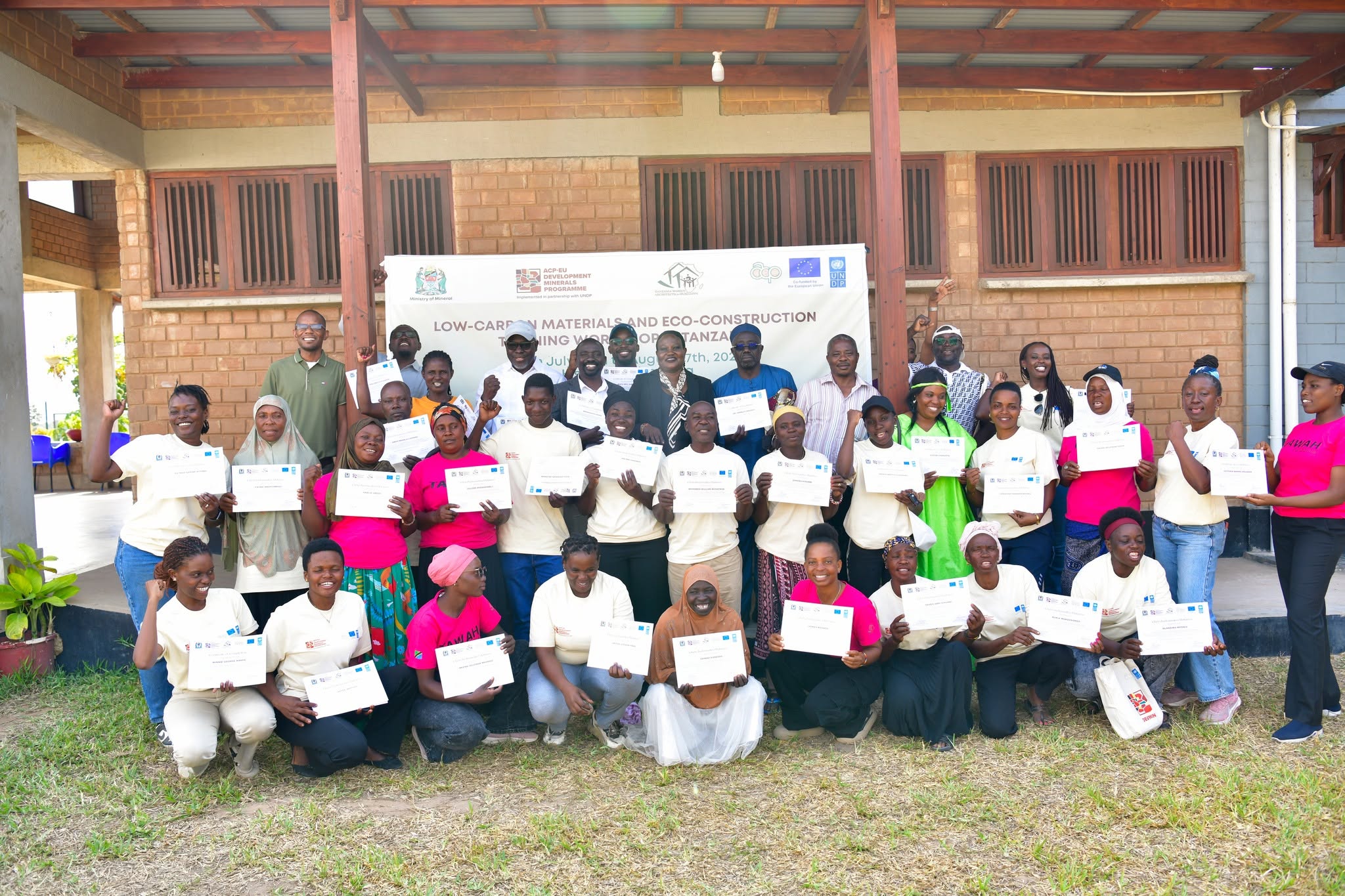
From 30 July to 17 August 2026, participants from Tanzania, Zambia and Uganda came together in Tanzania for the Low-Carbon Materials and Eco-Construction Training Workshop. An initiative of the ACP-EU Development Minerals Programme, the training was organized in partnership with the Organisation of African, Caribbean and Pacific States (OACPS), the European Union and UNDP, in collaboration with Tanzania’s Ministry of Minerals and Tanzania Women Architects for Humanity (TAWAH).
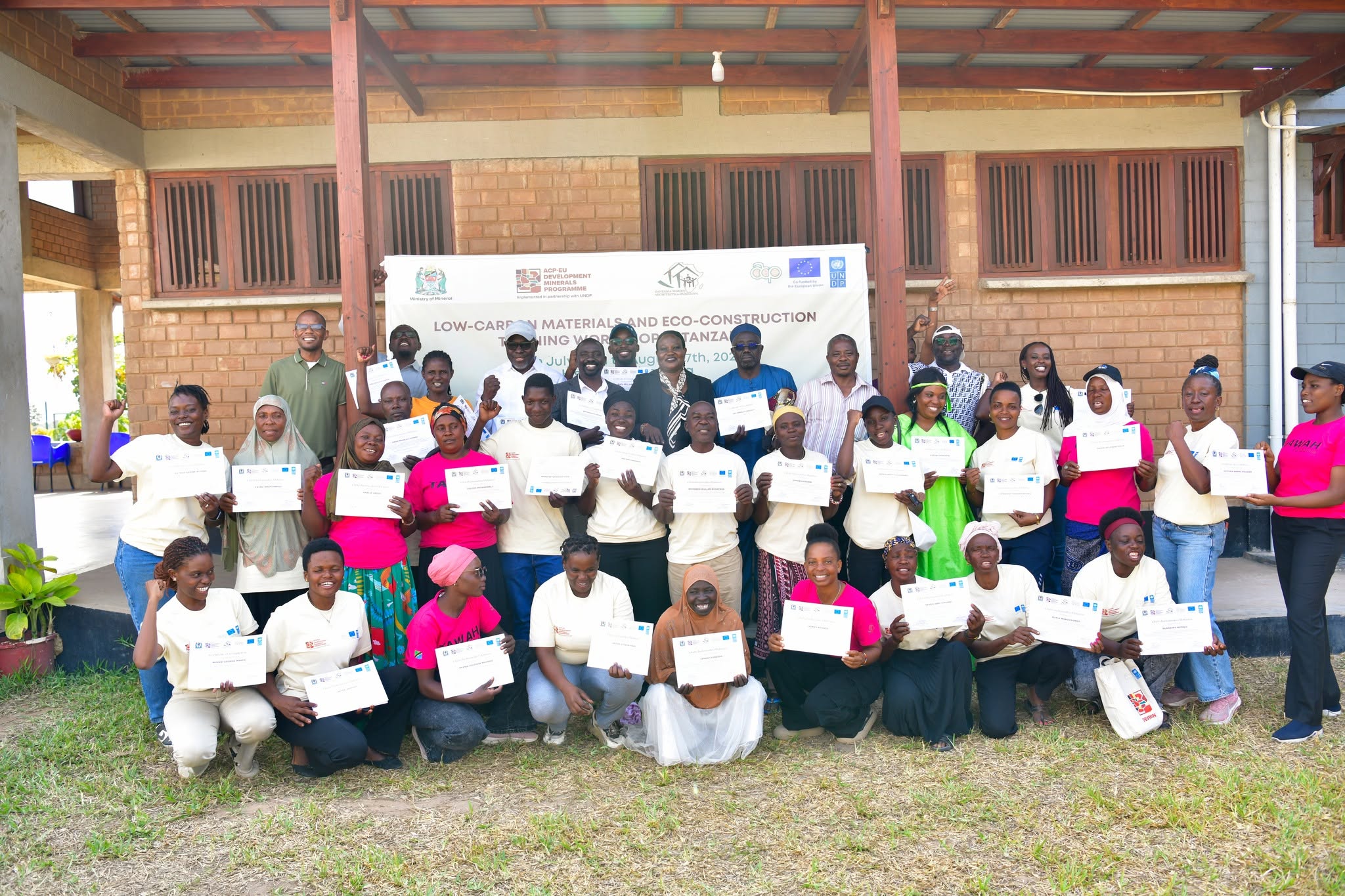
The training aimed to promote value addition to Development Minerals by equipping young women and men with practical skills in low-carbon materials and eco-construction. Combining classroom learning with hands-on training, participants explored how locally available minerals and agricultural waste can contribute to more sustainable construction and circular economy approaches. A strong focus was placed on the production of stabilized earth bricks, using locally available earth materials as a lower-carbon building solution.
The workshop opened with remarks from Uyanga Gankhuyag, Programme Manager of the ACP-EU Development Minerals Programme, who highlighted the importance of knowledge exchange across countries and building a network of future trainers. Amon Manyama, UNDP Tanzania Deputy Resident Representative, emphasized the potential of the training to empower women with practical skills in low-carbon materials and construction. Dr Victoria Marwa Heilman, CEO of TAWAH, highlighted the opportunity for participants to learn from one another and share their experiences.
Throughout the training, participants looked at the full value chain of construction materials, from responsible mineral exploration and extraction to the production and use of low-carbon building materials. Sessions addressed environmental, health, safety and community impacts, as well as key steps in responsible small-scale mining, including land and licence checks, permit requirements, exploration, sampling and testing.
Participants also explored the potential of agricultural waste, including cassava peels, sugarcane husks and rice husks, to reduce the amount of cement needed in construction materials. They learned about the properties of earth materials such as clay and laterite and how to select suitable materials for construction. This knowledge was then put into practice through hands-on sessions producing stabilized earth bricks and contributing to the foundation and walls of a demonstration building.
The training also included a visit to the Institute of Building Research in Dar es Salaam, where participants took part in practical laboratory demonstrations to better understand the physical characteristics and behaviour of soils and their importance for the quality, safety and performance of construction materials.
By combining technical learning, practical experience and regional knowledge exchange, the training equipped participants with skills they can apply and share in their communities and institutions. It also demonstrated how locally available Development Minerals can support value addition and more sustainable, lower-carbon approaches to construction.